


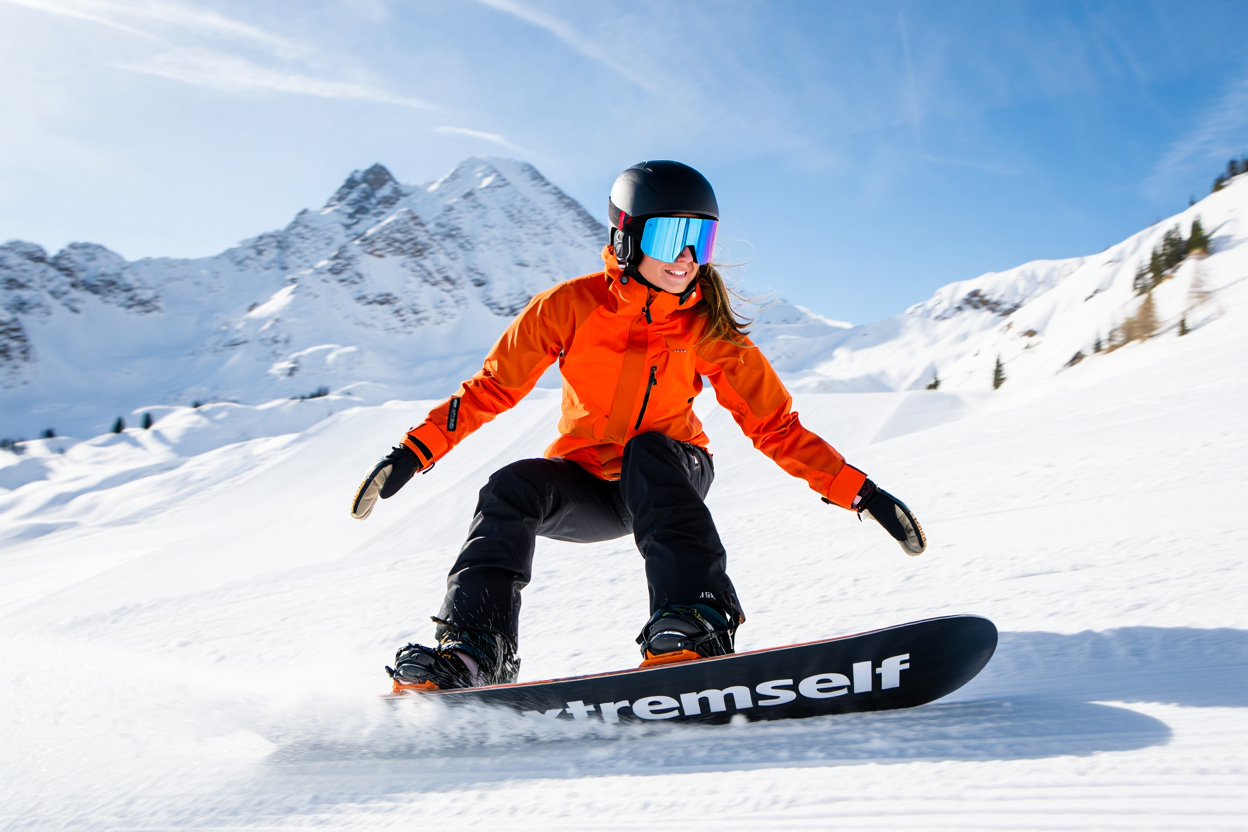
Snowboard gear for beginners comes down to seven items: a soft board, suitable bindings, comfortable boots, a helmet, goggles, waterproof gloves and a three-layer outfit. Rent the board, bindings and boots first; buy the helmet, goggles and clothing as a priority, because they have to fit you perfectly.
Snowboarding is a thrilling sport, but your first days depend heavily on your equipment. A board that is too stiff, boots that squeeze your calves or a jacket that lets water through is enough to turn a first taste into a struggle. For a woman, there is one more point: a large share of standard equipment is designed for heavier builds and bigger feet. This guide gives you the complete checklist, what is better rented (or hired, as UK shops say) and what is better bought, and the settings to check before you strap in. For the rest of your learning curve, keep our complete snowboarding guide for beginners close at hand.
What does a complete set of snowboard gear for beginners include?
Here is the minimum list of snowboard gear for beginners for a first day on the slopes. It holds for a single guided outing as well as for a week-long course.
| Item | What it does | Rent or buy? |
|---|---|---|
| Board | Glide, turn, brake | Rent at first |
| Bindings | Connect your boots to the board | Rent with the board |
| Boots | Transmit your movements to the board | Rent, then buy first |
| Helmet | Protect your head when you fall | Buy (or rent) |
| Goggles | See in wind, snow and sun | Buy |
| Gloves or mittens | Keep your hands dry: they touch the snow a lot | Buy |
| Jacket and pants | Stay dry and warm | Buy (or borrow) |
| Technical base layers | Wick sweat away | Buy |
On top of this base come protective items that are optional but very useful for a beginner: wrist guards and impact shorts. We come back to them below.
Which board should you choose as a beginner woman?
The board is the heart of your snowboard gear. To start out, look for a board that is soft and forgiving, as recommended by Glisshop’s beginner guide (in French): a soft flex forgives caught edges, those moments when the edge of the board digs into the snow and sends you tumbling.
Women’s board or unisex board?
Women’s boards are generally shorter, narrower and softer, to suit a lower average weight and a smaller average boot size. Rental platform Sendy points out, however, that these are trends, not rules: plenty of women ride very well on a unisex board. What really counts:
- Your weight: it determines the useful length and stiffness, far more than your height does.
- Your boot size: with a small foot on a wide board, you will struggle to tip the board onto its edge.
- Your level: a beginner benefits from going a little shorter and softer.
To find the right length, check our women’s snowboard size chart.
Which bindings and which angles?
To start out, go for soft bindings, which are less tiring on your legs. Always have the angles and stance width set by the rental shop. If you do not yet know whether you ride regular (left foot forward) or goofy (right foot forward), Glisshop suggests a symmetrical setting, for example +15° at the front and −15° at the back, so you can try both directions. Our guide to snowboard binding setup for women walks you through each adjustment.
How do you choose snowboard boots?
Boots are the most personal part of a beginner’s snowboard gear, and the one that hurts most when it is badly chosen. A boot that is too big costs you control of the board; one that is too tight cuts off your circulation and freezes your feet.
- Try boots on at the end of the day, with the ski socks you will actually wear.
- Standing up, your toes should just brush the end of the boot. Bend your knees: your toes should pull back slightly.
- Your heel should barely lift when you lean forward.
- Check the top of the cuff: if your calves are on the fuller side, a women’s boot or an adapted lacing pattern will prevent pressure points.
- Choose a soft to medium flex to begin with.
The Xtremself tip: if you were to buy only one technical item after your first days, make it the boots. Boots that fit your feet make every day more enjoyable, even on a rental board.
What protection should you wear when you start snowboarding?
On a snowboard, you mostly fall forward or backward, and the reflex is to catch yourself with your hands. Data from Médecins de Montagne, the French network of mountain doctors, published by Santé publique France (PDF, in French), highlight how common wrist fractures are in snowboarding, and indicate that beginners with fewer than 7 days of practice accounted for 33.3% of the injured over the season studied (2003). These figures are old, but the message still holds: your first days are the most exposed.
- Helmet: essential. It should fit snugly and be compatible with your goggles, with no gap on your forehead.
- Goggles: they protect you from wind, sun and flying snow. A lens suited to overcast days makes the terrain noticeably easier to read.
- Wrist guards: light and inexpensive, they are worn under your gloves.
- Impact shorts: they cushion falls on your backside and tailbone, which are very frequent at the start.
- Back protector: mostly useful if you are heading for the terrain park or off-piste, less essential on a green run.
No protection removes the risk. It limits the damage and, above all, gives you the confidence you need to commit to your turns. Also learn to get back up after a fall without loading your wrists: it is one of the first things covered in our first snowboarding lessons.
How do you dress for snowboarding without getting cold?
On a snowboard, you spend more time sitting in the snow than you do on skis, especially at the beginning. The golden rule is therefore waterproofing, particularly for your pants and gloves. Apply the three-layer system:
- Base layer: a technical top and leggings (synthetic or merino wool) that wick sweat away. Avoid cotton, which stays damp.
- Mid layer: a fleece or a thin insulated jacket that keeps the warmth in.
- Outer layer: a waterproof, breathable jacket and pants. A women’s cut avoids leg and sleeve lengths that do not suit you.
Add a neck warmer, tall ski socks (one pair only, not two) and mittens if your fingers get cold easily. For cuts, fabrics and the details worth paying for, see our guide to the women’s snowboard outfit.
Snowboard gear for beginners: should you rent or buy?
For snowboard gear for beginners, renting is the most sensible option during your first days: you try several boards without committing, and the shop sets up the bindings for you. The helmet, goggles and clothing, on the other hand, are well worth buying from the start: they also work for skiing and have to fit you perfectly.
Think about buying a board once you are linking your turns on blue runs and you know which style appeals to you. To place gear within your overall budget for a first trip, go back to our complete snowboarding guide for beginners.
The Xtremself tip: when you pick up your rental gear, ask to check three things: your stance (regular or goofy), the binding angles and how the straps tighten. Two minutes at the counter save you an uncomfortable morning.
Once you are kitted out, move on to our basic techniques for your first snowboarding lessons. Find all our advice in the Snowboarding section.
Read next in our “Snowboard gear” series:
- The complete snowboarding guide for beginners
- The women’s snowboard size chart
- Snowboard binding setup for women
- The women’s snowboard outfit
- Basic snowboarding techniques for your first lessons
- Learning to snowboard as an adult
Frequently asked questions
A board, bindings, boots, a helmet, goggles, waterproof gloves and a three-layer outfit. Wrist guards and impact shorts are strongly recommended for your first days.
No. Women’s boards are often shorter, narrower and softer, which suits many beginners. But your weight, your boot size and your level matter more than the label.
It is not always required for adults, but it is strongly recommended, especially when you are starting out and falls are frequent. Choose a helmet that fits snugly and works with your goggles.
They are recommended when you start. On a snowboard you often catch yourself with your hands, and wrist fractures are among the common injuries in snowboarders.
Rent the board, bindings and boots for your first days. Buy the helmet, goggles and clothing first, then the boots as soon as you plan to ride regularly.
