


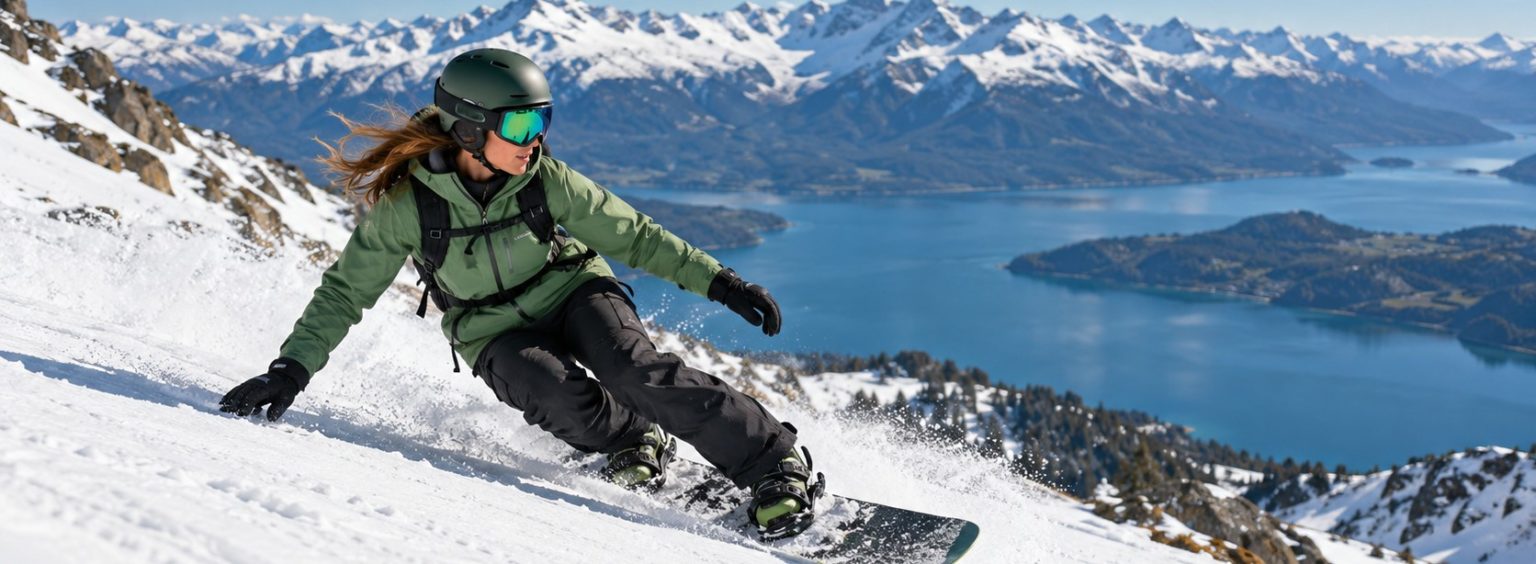
No, it is not too late to start learning to snowboard as an adult, at 30, 40 or beyond. What changes with age is how you learn: lessons from day one, a proper warm-up, wrist protection and shorter days. With that method and an instructor, your first turns come quickly.
Why a guide for women who start as adults? Because you rarely begin in the same conditions as a 12-year-old. You may be going with friends or a partner who already ride, with only a few days off, a body that recovers more slowly and a perfectly reasonable fear of falling. You may also be starting so you can share your children’s snow holidays. The good news: all of that is manageable, as long as you adapt your learning instead of trying to keep up with everyone else.
Is it really too late to learn to snowboard at 30 or 40?
No. The lesson platform CheckYeti makes the point: there is no age for learning to snowboard, and you meet adults of 20, 40 or 60 in lessons. Snow schools know it. As one example, the ESF ski school in Le Grand-Bornand, France, runs a beginner snowboard course (page in French) open from age 13 with no upper age limit, as five group lessons of 2 hours 15 minutes. Most resorts worldwide offer equivalent adult first-timer programmes.
The real question is not age but your fitness and health. If you have a history of knee, back, wrist or shoulder problems, or follow a particular treatment, ask your doctor before you go. They can point you to suitable strengthening exercises.
What changes when you start snowboarding as an adult?
At 30 or 40 you have strengths children do not have, and a few things to watch.
Your strengths
- Understanding instructions: you quickly grasp why you need to weight your front leg or look where you want to turn.
- Analysis: you spot your mistakes and can correct them from one session to the next.
- Motivation: you chose this sport, and you know why you are there.
What to watch
- Fear of falling: it tenses the body, and a tense body falls more. Learning to fall is part of learning to ride.
- Fatigue: thighs and glutes work hard at first. Falls often come at the end of the day.
- Recovery: a bruise or sprain takes longer to heal than at 20. Prevention beats cure.
The French association of mountain doctors, Médecins de Montagne, even describes a “second-day syndrome”: muscle soreness and unrecovered fatigue raise the risk of falling (article in French) the day after an intense first day, especially in people who do little sport. It is exactly the trap many adult beginners fall into during a short holiday week.
How does learning to snowboard unfold, step by step?
Everyone progresses at their own pace, and there is no standard timeline. The stages, however, are always the same. Here is the classic progression taught in lessons, with the sign that tells you it is time to move on.
| Stage | What you learn | You are ready for the next stage when… |
|---|---|---|
| 1. Basics on the flat | Finding your front foot (regular or goofy), strapping in, skating with one foot free | You glide a few metres with one foot strapped in without losing balance |
| 2. Side-slipping | Sliding down across the slope, on your heel edge then your toe edge | You control your speed and stop when you decide to |
| 3. Falling leaf | Sliding diagonally left then right without changing edge | You cross the run in both directions without falling |
| 4. First turn | Moving from one edge to the other while looking downhill | You link two or three turns on a gentle slope |
| 5. Linked turns | Connecting turns in rhythm, on green then blue runs | You ride a blue run in turns, without forced side-slipping |
Our complete guide to snowboarding for beginners goes through these first stages in detail.
Group lesson, private lesson or learning with friends: which to choose?
Learning alone or with a loved one who already rides is tempting, but rarely effective. A friend does not have an instructor’s teaching skills and usually wants to head for runs that are too hard for you. An instructor first teaches you to fall and to brake, which reassures you and gets you progressing faster.
- Group lesson: the most economical. Choose an adult beginner group so you progress at the same pace as the others.
- Private lesson: more expensive, but ideal if you are very apprehensive or only have two or three days.
- The mix: a few hours of group lessons in the morning, then gentle free practice in the afternoon to consolidate.
The Xtremself tip: book your lessons in the morning, when your legs are fresh, and stop as soon as your thighs burn or your attention drops. The “one for the road” run is often the one with the fall. Two well-used half-days beat one exhausting full day. Always listen to your body.
How do you prepare your body and limit the risk of injury?
Snowboarding injuries are not distributed as in skiing. According to Médecins de Montagne data reported by 24matins, the upper limbs account for 61% of injuries among snowboarders, against 29% among skiers, and wrist fractures are common. The reason is simple: as you fall, you instinctively reach for the snow with your hands.
To limit the risks, adopt these habits:
- Prepare a few weeks ahead: strengthen thighs, glutes and core, and work on balance (single-leg stands, a balance board if you have one).
- Warm up every morning: ankles, knees, hips, wrists and shoulders, for a few minutes before the first run.
- Wear a helmet, wrist guards and impact shorts: they do not remove all risk, but they cushion the falls beginners take most often.
- Learn to fall: forwards, land on your forearms and knees with fists closed; backwards, round your back and avoid putting your hands down behind you.
- Hydrate and take breaks: fatigue is your worst enemy in the first days.
What gear should an adult beginner choose?
For your first outings, rent your gear instead of buying. You can try different boards and find out whether you like the sport before investing. Ask the rental shop for a soft, forgiving board designed for learning, and comfortable boots that hold your heel well.
Board length depends mostly on your weight, height and boot size: check our women’s snowboard size chart before you go to the shop. For clothing, see our guide to the women’s snowboard outfit, and once you have your own board, our binding setup guide.
Find all our advice for progressing in the snowboarding section.
Read next in our “starting snowboarding” series:
- Snowboarding for beginners: the complete guide
- Ski or snowboard: which to choose?
- Women’s snowboard size chart
- Women’s snowboard outfit
Frequently asked questions
Yes. There is no age limit for starting, provided you are in good health and progress at your own pace. At 40, take lessons, warm up, wear protection and keep the first days short to avoid fatigue-related falls.
Children are less afraid of falling and recover faster. Adults make up for it with their understanding of instructions and their ability to analyse mistakes. The pace is often more cautious at first, but progress is real with good coaching.
It is strongly recommended. An instructor teaches you to fall, get up and side-slip in the first hours. These basics cut the number of falls and keep you from picking up bad habits that are hard to fix later.
A helmet is essential. In snowboarding most injuries affect the upper limbs, the wrists in particular, so wrist guards are very useful at first. Impact shorts also cushion falls on your backside and tailbone.
Skiing is often more accessible in the first days, while snowboarding needs a more marked adaptation period at the start. Once the first turns are in place, progress on a snowboard is often very rewarding.
