


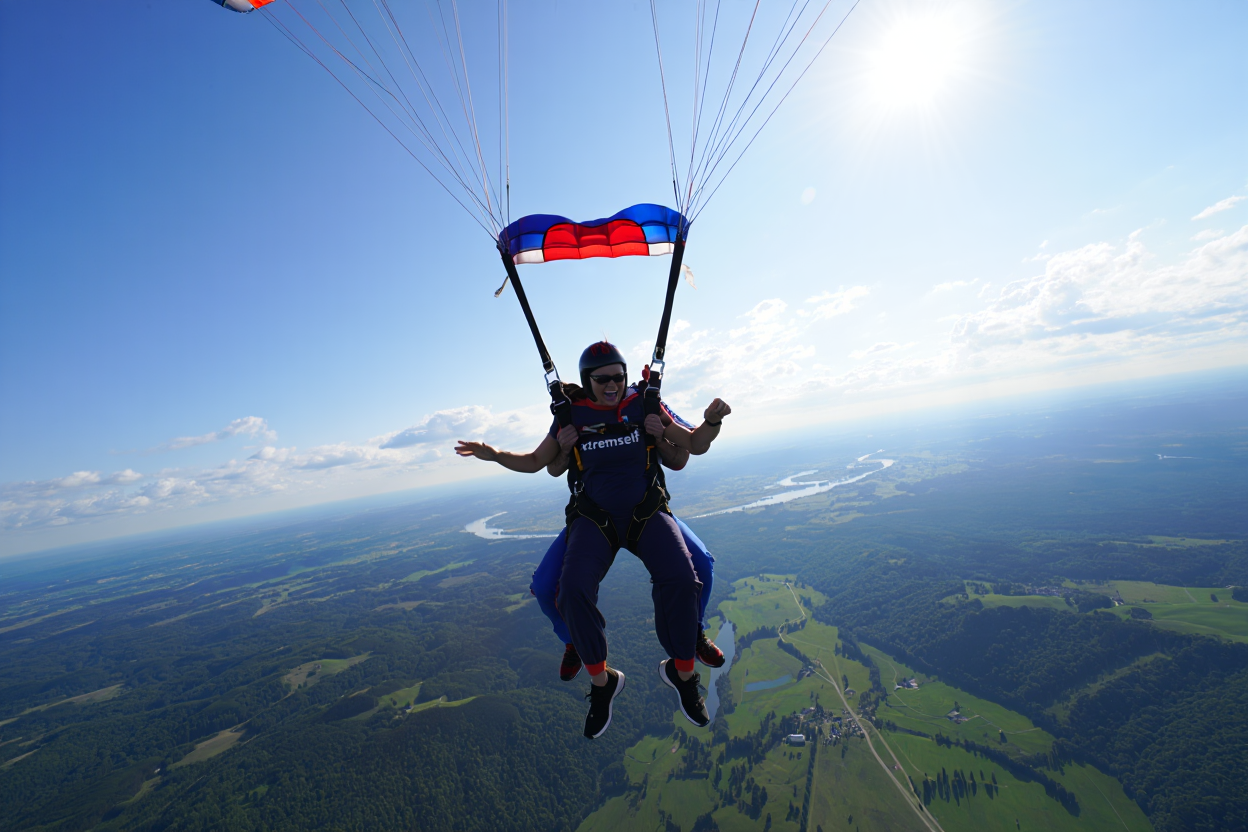
Safe skydiving technique rests on three skills learned on the ground: a stable exit from the aircraft, an arched, belly-to-earth position in freefall, then deployment at the planned altitude, at least 1,500 m (about 4,900 ft) during the French accompanied-freefall progression. The rest comes down to rigorous checks and respect for the weather.
This guide is for women preparing their first course or first solo jumps. A lighter build, a harness to adjust, nerves at the aircraft door: we start from those concrete questions, with figures from the French Parachuting Federation (FFP) as our worked example, so you know what to expect at each stage. Rules differ from country to country: in the United States the reference is the USPA, in the UK British Skydiving. Your school applies the rules of its own governing body, and those are the ones that count for you.
What are the stages of a skydive, from aircraft to ground?
A jump breaks down into short phases, each with its own actions. Every skydiving technique is learned on the ground first, then applied in the air:
- Gear check on the ground, then again on board: harness, handles, altimeter, helmet.
- Exit with a tight core and eyes on the horizon, no abrupt movement.
- Stable freefall in the arch position, with regular glances at the altimeter.
- Deployment sequence at the altitude set by your instructor, holding your position.
- Canopy check: shape, free steering toggles, clear airspace around you.
- Canopy flight and landing: follow the flight plan to the landing area, then flare at the right moment.
According to the skydiving guide from Sport Découverte (in French), freefall lasts 40 to 55 seconds depending on exit altitude, at a speed that can reach 200 km/h (about 125 mph) belly-to-earth. That sounds long on the ground. In the air it goes by very fast, hence the importance of the altimeter.
Skydiving techniques: which body position in freefall?
The basic position is the arch: belly towards the ground, hips pushed forward, arms and legs spread symmetrically. It keeps you facing the earth without excessive effort.
- Hips forward, back arched but not tense.
- Arms open at head or shoulder height, elbows bent.
- Legs slightly apart, knees a little bent.
- Head up, eyes on the horizon, not straight down.
- Steady breathing: tension makes the position stiffer and harder to hold.
Any asymmetry, such as one arm lower or one leg tucked, makes you turn or tip. Instructors correct these technique errors with hand signals in freefall, then in the video debrief. A wind tunnel (indoor skydiving) lets you work on the position for several minutes at a stretch, which is why many students book tunnel time before or during their course.
At what altitude do you open your parachute?
Minimum opening altitudes are set by each national body. As an example, here are those laid down by technical directive no. 49 of the French Parachuting Federation (FFP, in French), applicable since 1 April 2026. They depend on your level:
| Situation | Minimum opening altitude |
|---|---|
| Accompanied-freefall student, levels 1 to 4 (exit at 3,000 or 3,500 m / about 10,000 or 11,500 ft) | 1,500 m (about 4,900 ft) |
| Static-line progression student, levels 3 and 5 | 1,200 m (about 3,900 ft) |
| A licence holder (lowered progressively) | 1,200 m (about 3,900 ft) |
| B licence holder | 1,000 m (about 3,300 ft) |
| Holder of the French autonomous skydiver licence (BPA) | 850 m (about 2,800 ft) |
These are minimums, and they are the French ones. Your instructor sets the actual altitude for each jump, and that instruction always overrides the urge to stay in freefall longer.
How does student progression work, up to the A licence?
The French accompanied progression (PAC), the equivalent of Accelerated Freefall (AFF) in English-speaking countries, has you in freefall from the very first jump, with instructors beside you in the air. The federation’s directive divides it into 4 levels:
- Level 1: on exit you are held by two instructors, who stay with you for as long as your safety requires.
- Level 2: one instructor holds you on exit, up to and including the second jump.
- Before level 4: at least 6 accompanied jumps.
- A licence: a minimum of 12 freefall jumps, at least 5 of them solo.
For the French A licence you must also complete flat 360° turns in both directions, turn 90° off the line of flight and hold a “track” (horizontal movement) on heading for 5 seconds. Under canopy, you are asked to recognise the stall, turn at 50% brakes, link 360° turns on the toggles and on the rear risers, then land unaided in the planned area. Requirements vary elsewhere: the USPA A license in the United States, for instance, requires a minimum of 25 jumps.
The other route, the static-line progression, starts with automatic-opening jumps: the canopy is opened by a line attached to the aircraft, before any move to freefall. In France the exit is then at 1,000 m (about 3,300 ft) minimum.
Which safety rules frame every jump?
Again taking the French rules as the example:
- Automatic activation device (AAD): it must be fitted and switched on for every skydiver, on every jump.
- Certified helmet: mandatory until you hold the autonomous licence.
- Ground wind: until you have the A licence, no jumping above 7 m/s (about 14 knots). The limit rises to 11 m/s (about 21 knots) for higher licences.
- Reserve parachute: French sports law, cited by FFP technical directive no. 50 (in French), requires it to be repacked at least once a year by a qualified person. Repack intervals differ in other countries.
- Buddy check: have your gear checked by an instructor before boarding, then recheck your handles on board.
These rules reduce the risk; they do not remove it. Skydiving remains a risk activity: your best protection is to follow the school’s instructions, even when they delay your jump.
The Xtremself tip: before every boarding, recite your jump plan out loud: opening altitude, jump run, landing area and emergency procedures. If any of those points escapes you, ask before you get on the plane.
What should a woman starting skydiving watch out for?
Skydiving technique is the same for everyone. Some details matter more, though, when you have a light or slim build.
- The harness: it must be adjusted to your size, leg straps and chest strap included. Flag any strap that is loose or digs in before the jump.
- The student canopy: under the same canopy, a lighter person flies more slowly and lands more softly. Those easy landings can hide piloting errors: ask for canopy debriefs as well.
- The jumpsuit: a fitted suit limits the flapping fabric that destabilises you.
- Stress: it is normal. Breathing, visualisation and rehearsing the moves on the ground help channel it.
- Health: pregnancy, a recent injury, ongoing treatment, a history of heart problems: ask a doctor before you sign up, and find out which medical declaration or certificate your school requires.
To understand the equipment you will be handed, read our guide to parachutes for beginners, and find all our guides in the skydiving section.
Frequently asked questions
Belly-to-earth, speed can reach about 200 km/h (125 mph), for a freefall of 40 to 55 seconds depending on exit altitude.
In France, at 1,500 m (about 4,900 ft) minimum at every level of the accompanied-freefall progression, under FFP technical directive no. 49. Other countries set their own minimums: your school will tell you the altitude for each jump.
It depends on the country. The French A licence requires a minimum of 12 freefall jumps, at least 5 of them solo, with validated freefall and canopy exercises. The USPA A license in the United States requires a minimum of 25 jumps.
Students have a ground-wind limit: 7 m/s (about 14 knots) under French rules. The school decides on the day: a postponed jump is part of the sport.
In FFP-approved schools in France, yes: it must be fitted to the rig and switched on for every skydiver. It backs up your own actions; it does not replace them.
Read next in our technique and safety series:
