


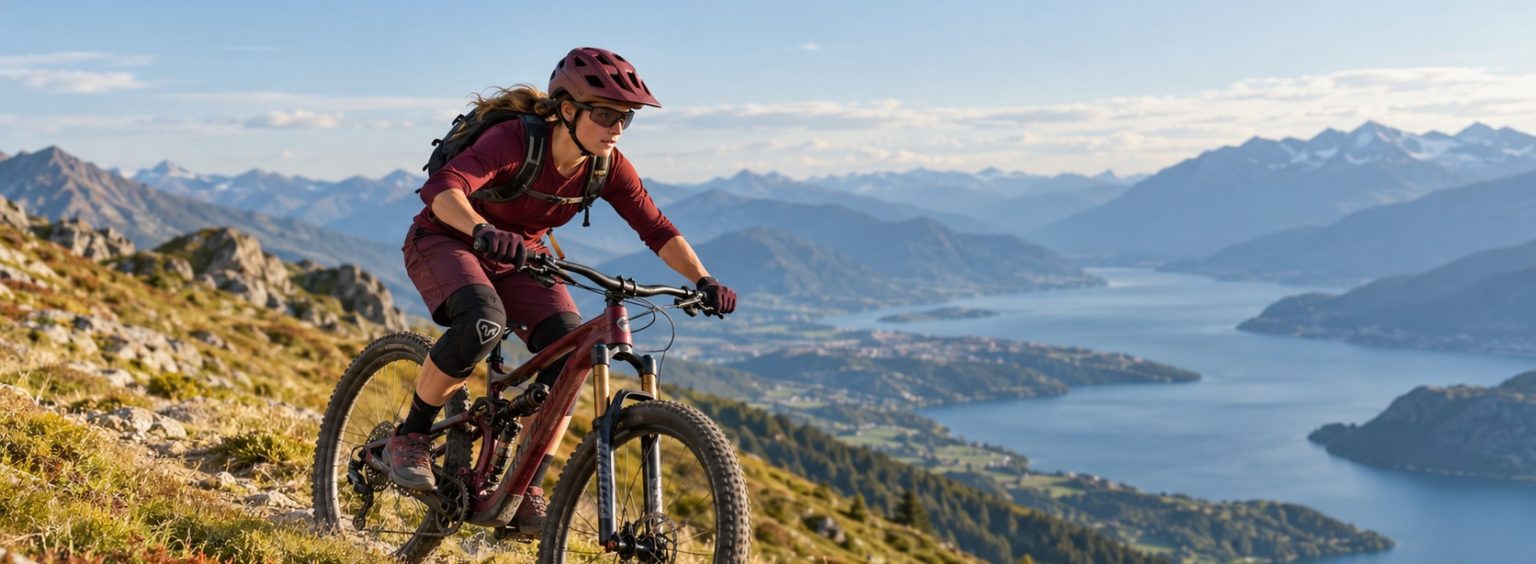
To choose your MTB frame size, start from your height and inseam: a woman between 1.60 and 1.70 m (5’3″ to 5’7″) usually rides a size S. Then check the model’s reach, the horizontal length of the frame, and keep 6 to 8 cm (about 2.5 to 3 in) of standover clearance.
Why a guide written for women? Because size charts are often built on male averages. Yet as Liv, the brand that designs bikes for women (page in French), points out, the factor that weighs most on geometry is not height alone but the ratio between torso length and leg length. On average, women have a shorter upper body and longer legs. On a frame that is too long you end up stretched out, arms locked, with weight on your wrists. The good news: with three measurements and a bit of method you can find the right frame, in the women’s range or the unisex one.
Why does frame size matter so much on a mountain bike?
On a mountain bike you move constantly: standing on descents, hips back on steep pitches, forward on climbs. A frame that fits gives you that freedom of movement. The e-bike retailer Upway (in French) sums up the two pitfalls well:
- A frame that is too big stretches you: extended position, loaded wrists and shoulders, a bike that is harder to handle in technical sections.
- A frame that is too small cramps you: knees close to the bars, reduced mobility, an inefficient position for long hours of pedalling.
Some adjustments correct a great deal, but not an ill-fitting frame.
Which measurements should you take before choosing a mountain bike?
Three numbers are enough to start: your height, your inseam and, if possible, your arm length. Measure your inseam like this, following the method described by Decathlon (in French):
- Stand barefoot with your back and heels against a wall, legs slightly apart.
- Slide a hardback book horizontally between your thighs, as high as it will go, snug against the perineum, as if you were sitting on a saddle.
- Measure from the floor to the top edge of the book, keeping the tape parallel to the wall.
- Repeat twice and keep the average. Get someone to help: alone, it is easy to skew the result.
Then compare your inseam with your height. If your inseam is long relative to your height, you have long legs and a short torso, a common profile among women. That detail will help when you hesitate between two sizes. Note that this is your cycling inseam, usually longer than your trouser inseam.
Which MTB frame size for your height? The chart
This chart combines two references: the seat-tube frame size given by the Alpiniste frame calculator (in French) and the letter size with trail-bike reach given by Decathlon. These are indicative ranges: every brand has its own chart.
| Your height | Indicative frame size | Usual size | Indicative reach (trail bike) |
|---|---|---|---|
| 1.50–1.55 m (4’11″–5’1″) | 33–36 cm (13–14″) | XS | under 400 mm |
| 1.55–1.60 m (5’1″–5’3″) | 35–38 cm (14–15″) | XS or S | under 400 mm to 425 mm |
| 1.60–1.65 m (5’3″–5’5″) | 38–40 cm (15–16″) | S | about 425 mm |
| 1.65–1.70 m (5’5″–5’7″) | 40–43 cm (16–17″) | S | about 425 mm |
| 1.70–1.75 m (5’7″–5’9″) | 42–45 cm (16.5–17.5″) | M | about 450 mm |
| 1.75–1.80 m (5’9″–5’11”) | 44–47 cm (17.5–18.5″) | M or L | 450 to 475 mm |
For smaller riders, Upway advises looking, below 1.60 m (5’3″), at XS models with a reach under 400 mm. Also note that a cross-country bike often has a shorter reach than a trail bike in the same size. Always look at the geometry chart of the exact model. Reach and stack are quoted in millimetres by every brand, whatever the country.
What is reach, and why look at it first?
Reach is the horizontal distance between the centre of the bottom bracket and the top of the head tube. Its vertical counterpart is called stack. For Decathlon it is the most reliable indicator, because it does not depend on seat-tube length, which varies enormously from brand to brand.
In practice, how do you read a geometry chart?
- Short reach: a more agile, playful bike and a more upright position. Ideal if you have a short torso or are just starting out.
- Long reach: a bike that is more stable at speed, with a more stretched position.
- High stack: a taller front end, with less weight on hands and shoulders.
A geometry with a fairly short reach and a fairly high stack suits many women’s proportions, whether or not it is sold as a “women’s” bike.
Should you choose a women’s MTB or a unisex one?
Both approaches exist. Some brands, such as Liv, design their frames from women’s body-dimension data and also adapt the handlebar, stem, cranks and saddle. Others offer unisex frames in small sizes, with adapted contact points.
The right reflex: compare the numbers, not the label. If you are tall with long arms, a unisex frame will often fit better. If you are petite with a short torso, favour a women’s model or a unisex frame with a short reach.
The Xtremself tip: write down your height, your inseam and the reach of a bike you feel good on today (yours, a friend’s, a rental). That reach figure becomes your personal benchmark: it lets you compare any model, whatever letter is printed on the frame.
How do you check the size on a test ride?
Nothing replaces a test ride, in a shop, at a demo day or with a rental. Here is what to check, based on Decathlon’s reference points:
- Standover: standing over the bike with your feet flat, you should have 6 to 8 cm (2.5 to 3 in) between the top tube and your crotch.
- Arms: after twenty minutes or so of riding, your elbows are still slightly bent, and you do not have to lock your arms to reach the bars.
- Movement: standing on the pedals, you can shift your hips back behind the saddle and forward again without being hindered.
- Comfort: no pain in the wrists, neck or lower back.
Between two sizes, take the smaller if you love technical trails or have long legs and a short torso. Take the larger if you want stability on long rides or have a long torso.
Which adjustments fine-tune an almost perfect frame?
Once you have the right frame, a few adjustments finish the job. Upway mentions a handlebar about 5 cm (2 in) wider than your shoulders on each side, a short 50 to 60 mm stem to relieve the shoulders, and a saddle height that leaves your leg almost straight at the bottom of the pedal stroke. The saddle deserves particular attention: see our guide to the women’s MTB saddle, and our advice on women’s MTB clothing, to ride for hours without discomfort.
These adjustments will not rescue a frame that is too big, however: Liv notes that a shorter stem can reduce your reach to the bars by 10 to 50 mm, without being equivalent to a geometry that fits. And whatever your bike, wear a helmet, gloves and knee pads. Find all our advice in the mountain biking section.
Read next in our “choosing and equipping your MTB” series:
- Mountain biking for beginners: the guide
- Women’s MTB saddle: ending discomfort
- Women’s MTB clothing: what to wear
Frequently asked questions
At 1.60 m you sit on the border between XS and S depending on the brand. Indicative charts give a frame of about 35 to 40 cm (14 to 16 in). Above all, check the model’s reach: a short reach, around 400 to 425 mm, will give you a more comfortable position.
No. A women’s MTB may suit you if you have a short torso and long legs, but many women ride very well on a unisex frame. Compare geometries and test ride: fit matters more than the label.
Barefoot, back against a wall, slide a hardback book horizontally between your thighs, snug against the perineum. Then measure from the floor to the top edge of the book. Get help for a reliable result.
Take the smaller if you want agility or have long legs and a short torso. Take the larger if you prioritise stability and long rides, or have a long torso.
Only partly. A shorter stem brings the handlebar a few centimetres closer, but it corrects neither the standover height nor the overall balance of the bike. It is better to start with the right frame size.
