


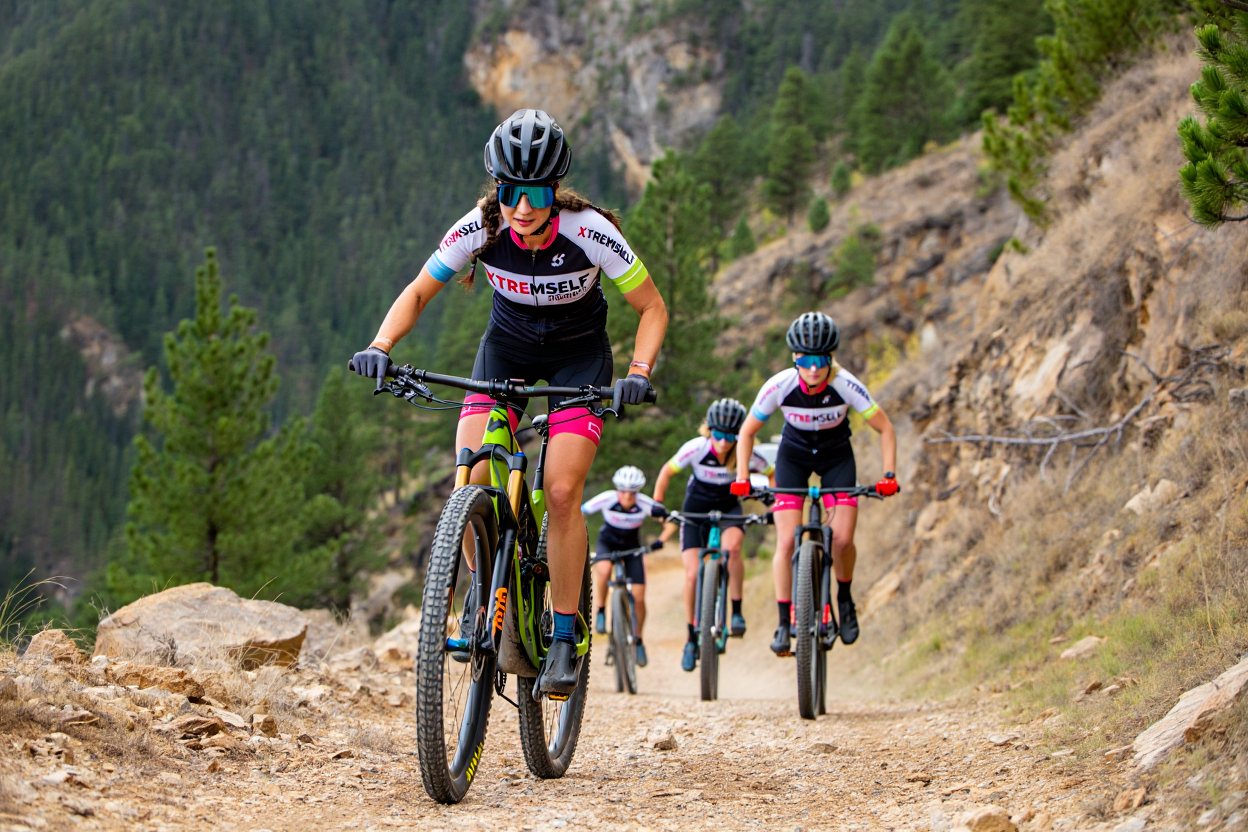
Good women’s MTB clothing comes down to five pieces: padded shorts with a women’s chamois worn without underwear, a breathable jersey, gloves, a windproof or waterproof jacket and shoes that suit your pedals. Add layers for the weather: below about 18°C (64°F), switch to full-length tights.
A mountain bike takes you from flat to steep climbs, from mud to sunshine, sometimes in a single ride. What you wear affects your comfort as much as your safety. Get it wrong and you face chafing, a painful saddle after an hour or a chill on the descent. This guide helps you put together your women’s MTB clothing piece by piece, allowing for your body, the season and how long you ride. Just starting out? Begin with our mountain biking guide for beginners.
Why MTB clothing designed for women?
The main difference is at the pelvis. Women’s shorts have a pad (the chamois) that should, according to Decathlon’s guide to women’s cycling shorts (in French), follow female anatomy: its shape, width and density zones are not placed as on a men’s model. The cut changes too: more room at the hips, often a higher waist, and bib straps that avoid compressing the bust.
Wearing men’s shorts “because they were in the drawer” is one of the most common causes of irritation among beginners. The same reasoning applies to the saddle: if pain persists despite good shorts, read our article on choosing a women’s MTB saddle.
Lycra shorts or baggy MTB shorts: which to choose?
It is the first question to ask yourself. Both options have their fans, and you can combine them.
Padded Lycra shorts: comfort over time
Close-fitting, they limit friction and keep the pad in place. Choose the pad level by the length of your rides. Decathlon distinguishes three levels:
| Length of your rides | Recommended pad |
|---|---|
| Under an hour | Level 1: single-density foam or gel |
| 1 to 3 hours | Level 2: multi-density foam |
| Over 3 hours | Level 3: very high-density foam |
For mountain biking, pick a tougher fabric than for the road: brambles, branches and crashes wear thin shorts out fast. As for shape, waist shorts are easier to pull on and are enough for short rides. Bib shorts stay put better on long rides and do not dig into your stomach. Some women’s bibs have a drop-seat zip or detachable straps, so you can take a nature break without removing your top.
Baggy MTB shorts: freedom and style
Looser, they are usually worn over padded shorts or a padded liner. Decathlon’s advice blog (in French) lists their strengths: zipped pockets, a cut that leaves room for knee pads and better resistance to snags. They are the usual choice for trail, enduro and downhill. Just check that they work with a liner underneath and do not catch on the saddle when you shift your weight back on steep sections.
Should you wear underwear under padded shorts?
No. Padded shorts are designed to be worn next to the skin. Underwear adds seams right where you are most sensitive, holds moisture and causes chafing. The retailer Alltricks (in French) and Decathlon give the same instruction.
During your period, Decathlon recommends a menstrual cup or tampon and advises against pads, which rub and shift. Period cycling shorts with a built-in absorbent layer also exist. Change as soon as the ride is over: staying in damp shorts encourages irritation and yeast infections. If irritation persists, talk to your doctor or gynaecologist.
The Xtremself tip: keep a full change of clothes in the car (underwear, shorts, T-shirt) and a wipe. Getting out of damp shorts within ten minutes of finishing makes a real difference to your skin.
What top should you wear mountain biking?
The jersey has to wick sweat and dry fast. Avoid cotton, which stays wet and chills you on the first descent. A women’s cut stops the jersey flapping or riding up: with waist shorts, check that it covers your lower back when you are leaning over the bars.
For a bra, choose a medium- or high-support sports bra in a technical fabric, with no underwire that could hurt you in a crash. Rough trails shake you about a lot.
Which accessories complete the outfit: gloves, jacket, shoes?
- Gloves: they protect your palms in a fall and improve grip when your hands sweat. Full-finger, lightly padded gloves suit most riding. Buy women’s sizes: fingers that are too long reduce your feel on the brake levers.
- Jacket: a packable windproof fits in a pocket or pack and saves you on descents. In the rain, go for a waterproof, breathable jacket with a helmet-compatible hood.
- Shoes: with flat pedals, choose a flexible, grippy sole. With clipless pedals, you need shoes compatible with your cleats. Either way, good heel hold and toe protection are a plus.
- Socks: technical fabric, tall enough to protect against brambles and trail spray.
- Helmet and pads: not strictly “clothing”, but essential. A helmet on every ride, and knee pads as soon as the trails get technical.
How do you adapt your MTB clothing to the weather?
The three-layer principle works on the bike too: one layer to wick sweat, one to insulate, one to block wind and rain. Start slightly cool: you will warm up quickly on the first climb.
| Conditions | Bottom | Top | Carry with you |
|---|---|---|---|
| Summer, dry | Short padded shorts, or baggies over a liner | Short-sleeve jersey, sunscreen | Light windproof |
| Spring and autumn (below about 18°C / 64°F) | Full-length or three-quarter tights | Long-sleeve jersey or arm warmers | Windproof, full-finger gloves |
| Winter, cold | Thermal tights | Technical base layer plus thermal jersey | Waterproof jacket, warm gloves, neck warmer |
| Rain | Tights or water-repellent baggies | Technical jersey | Hooded waterproof jacket |
The 18°C threshold for switching to long tights is the one given by Decathlon. Adjust it to your own sensitivity to cold and to the wind: a fast descent at 15°C (59°F) feels a great deal colder.
How do you choose your size and care for your kit?
- Try it on in position: lean forward as on the bike. The shorts should neither bunch at the crotch nor squeeze your stomach; the pad should stay flat against you.
- Aim for close-fitting shorts and jersey, and a slightly roomier jacket that goes over a warm layer.
- Wash after every ride: Decathlon advises a 30°C (cool) machine wash with an 800 to 1,000 rpm spin, without leaving the shorts to soak.
- Air dry, out of direct sun and away from radiators, to preserve the stretch and the foam.
- Replace your shorts when the pad packs down: Alltricks puts their lifespan at 1 to 2 years depending on use.
Well-fitted kit does not make up for a badly set-up bike. To go further, see our guide to women’s MTB frame size, or the whole mountain biking section.
Read next in our comfort and position series:
Frequently asked questions
Women’s padded shorts (or baggy MTB shorts over a padded liner), a breathable technical jersey, gloves, a light windproof and shoes with a grippy sole. Add a well-fitted helmet: it is essential from the very first ride.
No. Padded shorts are worn next to the skin. Underwear adds seams and moisture, which causes chafing and irritation.
Padded Lycra shorts give the best comfort on long rides. Baggy MTB shorts worn over a padded liner are tougher, more discreet and practical with knee pads. Many riders combine the two.
Decathlon sets the benchmark at 18°C (64°F): below that, full-length tights protect better against cold and wind. Adjust to your own sensitivity and the speed of the descents.
Choose women’s shorts in your size, wear them without underwear, wash them after every ride and change as soon as you finish. Chamois cream can help. If irritation persists, see a doctor.
