


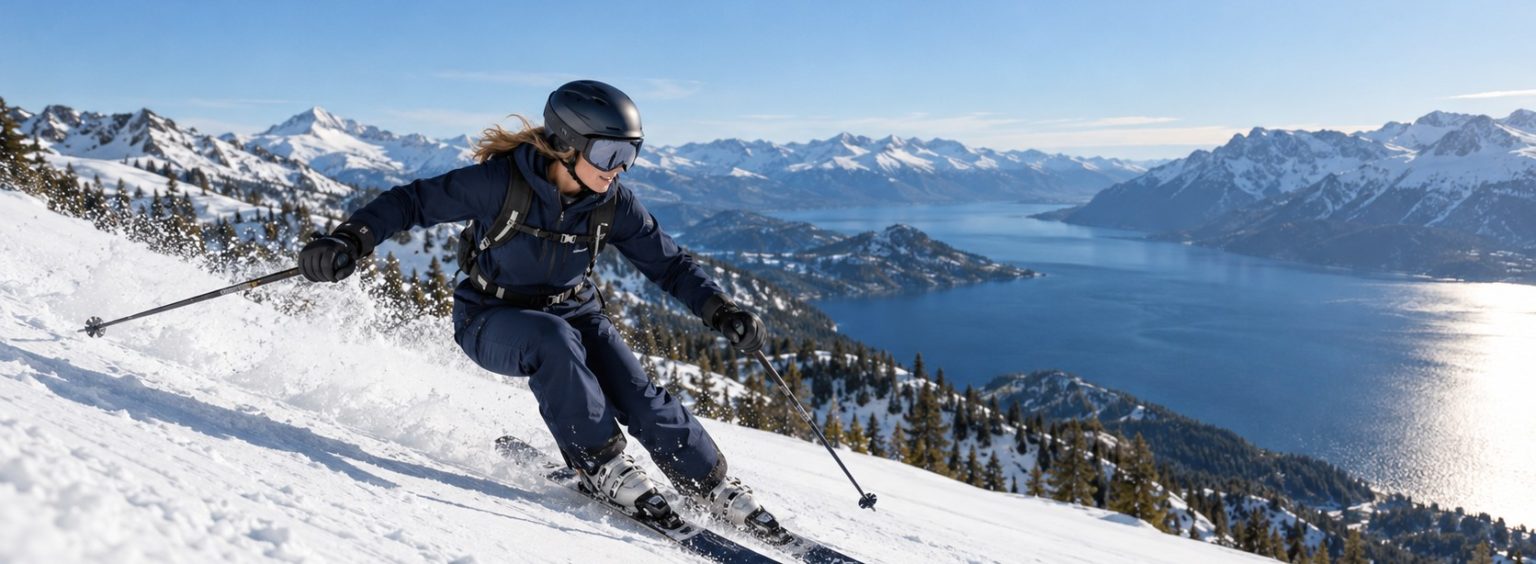
For women learning to ski, the fastest route is to take lessons for the first two or three days, rent gear matched to your level and build, stay on green then blue runs and move forward in stages. It is never too late: adults learn to ski very well.
Why a women’s guide to skiing for beginners? Because beginner advice is nearly always written for an average skier who is taller and heavier than most women. Yet build changes the choice of skis, boot size and the way you balance over them. Then come the questions we rarely ask out loud: fear of slowing the group down, coping with the cold, a body that changes through life, confidence to rebuild after a fall. This guide gathers the essentials for a good start, then points you to our features on gear, technique, the mountains and health. You will find all of them in the women’s skiing section.
Skiing for beginners: where do you start?
The first decision is simple: take lessons. CheckYeti’s guide for adults recommends that you take lessons for the first 2 to 3 days (guide in French), and notes that more than a third of people in beginner ski lessons are adults. As a beginner woman you will not be alone among the children. The French booking site Ski-Planet recommends at least one or two lessons with an instructor to learn the basics without picking up bad habits.
Group lesson or private lesson?
A group lesson is the cheapest option and a good way to meet other beginners. A private lesson costs more but adapts to your pace and your apprehensions. A formula that works well: a few group sessions to learn the basics, then an hour or two one-to-one to unlock a specific point, such as the first turn or fear of the slope. Many resorts and ski schools also run women-only clinics, worth a look if that setting suits you.
The first steps, in order
- Clicking in and out of your skis on your own, walking and sliding on the flat.
- Learning to fall and get back up: falling is part of learning.
- Braking and turning in a snowplough (the “pizza” or wedge) on a very gentle slope.
- Riding your first lifts (magic carpet, beginner drag lift or slow chair).
- Linking turns on a green run, then on a blue.
This progression follows the basics listed by Ski-Planet for learning to ski as an adult (in French). Many resorts have free beginner areas or reduced lift tickets limited to one or two lifts: ideal for the first days, without paying for the whole mountain.
How long does it take a beginner to learn to ski?
According to CheckYeti, turns on a blue run are generally mastered after three days of lessons, and one or two more days of practice let you ski a blue on your own by the end of the first week. The same guide notes that in the Alps blue runs have a gradient below 25% and reds a maximum of 40%. Everyone moves at their own pace: fitness, fatigue and confidence count as much as technique.
A note on colours: in Europe runs go green, blue, red, black. In North America there is no red: green circles are easiest, blue squares intermediate, black diamonds advanced. A European blue is roughly an easy North American blue.
To place yourself in the right lesson group, ski schools use an adult scale. Here are the levels as presented in Club Med’s guide to ski levels (in French); North American schools often use a 1 to 9 scale that follows the same steps:
| Level | What you can do | Suggested terrain |
|---|---|---|
| A | You have never skied | Beginner area |
| 1 | You can make snowplough (wedge) turns | Green runs |
| 2B | Your skis are almost parallel in turns | Greens and easy blues |
| 2A | You make wide parallel turns | Blue runs |
| 3B | You are comfortable with parallel turns | Blues and reds (harder blue squares) |
| 3A | You handle every type of groomed run | Reds and blacks |
| 4 | You ski all snow, all terrain | Guided off-piste |
The “suggested terrain” column is indicative: it follows from the level descriptions, not from an official rule. If in doubt, ask the ski school to assess you on a short run.
What ski gear does a beginner woman need?
For your first trips, rent. Rental shops renew their fleets regularly and advise you according to your level, height and weight. Short, soft, forgiving skis tolerate mistakes and make turning easier. Women’s ranges are often lighter and softer: a plus if you are on the light side, but the right ski is the one that matches your build and level, whatever the label says.
The most important item is the boot: too big, and it hurts and robs you of control. It should feel snug, with your toes brushing the front when you stand straight and pulling back when you flex forward. Add a helmet, recommended to prevent head injuries, goggles or sunglasses suited to the weather, technical base layers and warm gloves or mittens.
How do you progress after the first days?
Once parallel turns are in place, progress comes from three levers: looking well ahead, standing centred over your skis and using your edges instead of skidding. Carving, the clean arced turn that gives that smooth gliding feeling, is the natural next step. To build confidence, work on balance and feel as well: single-leg exercises at home train the proprioception your body uses to “read” the snow.
Ski with people of your level: following a group that is too fast pushes you into risks and slows your learning. And set progressive goals (a new blue run, an easy red on a sunny day) rather than a performance to hit at all costs.
When should you try off-piste and ski touring?
Off-piste and ski touring attract more and more women. They do require a solid level on groomed runs and, above all, real mountain knowledge: avalanche awareness, the right safety equipment and the training to use it. Before leaving marked runs, always go with a qualified guide or instructor. For a gentler first approach, starting ski touring on marked uphill routes is an excellent way in.
How do you prepare your body for a first ski trip?
Skiing works the thighs, glutes, core and knees hard. A few weeks of strength work before the season reduces fatigue and improves control at the end of the day, when falls are more frequent. Squats, lunges, wall sits and planks, two or three times a week, are a simple base you can do at home. On the trip, stretch, hydrate and sleep: recovery is what lets you string the days together.
If you are pregnant, read our guide to skiing while pregnant first; if you are coming back from an injury or have any doubt about your health, ask your doctor before you click in.
What will you find in our women’s ski features?
This guide to skiing for beginners is the gateway to the section. Each feature goes deeper into one stage of your journey, from the first rental to your first days out in the mountains.
Ski gear
Boots, goggles, accessories: how to choose equipment suited to your body without overpaying for options you do not need at your level.
Technique and progression
From carving to reading the snow, for those who want to step up, all the way to advanced technique and first competitions.
Off-piste and mountains
Avalanche safety, ski touring, freeride equipment for women: everything to know before leaving the groomed runs, with an eye on skiing more responsibly.
Body and health
Physical preparation, recovery and prevention: skiing longer, with less pain, taking the specific needs of women’s bodies into account. It does not replace advice from a doctor or physiotherapist.
The Xtremself tip: on day one, stop before you are exhausted. The “one last run” when your legs no longer respond is the riskiest of the day. Better a good memory and some strength left for tomorrow.
Still torn between two ways of sliding? Our comparison ski or snowboard for beginners helps you choose according to your tastes and fitness.
Our women’s ski features:
- Ski or snowboard: which one to start with?
- Ski touring for women: getting started step by step
- Skiing while pregnant: is it safe?
- All our women’s skiing articles
Frequently asked questions
There is no age limit. A motivated adult in good physical condition learns just as well as a child, provided they take lessons and progress at their own pace. If you have any doubt about your health, ask your doctor.
Plan lessons for the first two or three days. According to CheckYeti, turns on a blue run are generally mastered after three days of lessons, and one or two days of practice then let you ski a blue run on your own.
No. For your first trips, renting is cheaper and lets you try skis suited to your level. If you want to buy one item, start with boots, which determine comfort and control.
Not necessarily. Women’s models are often lighter and softer, which suits lighter skiers. The deciding factor is the match between the ski and your weight, height and level.
Stay on runs suited to your level, ski with people who go at your pace and work on one point at a time with an instructor. Confidence comes from repetition on terrain you control.
