


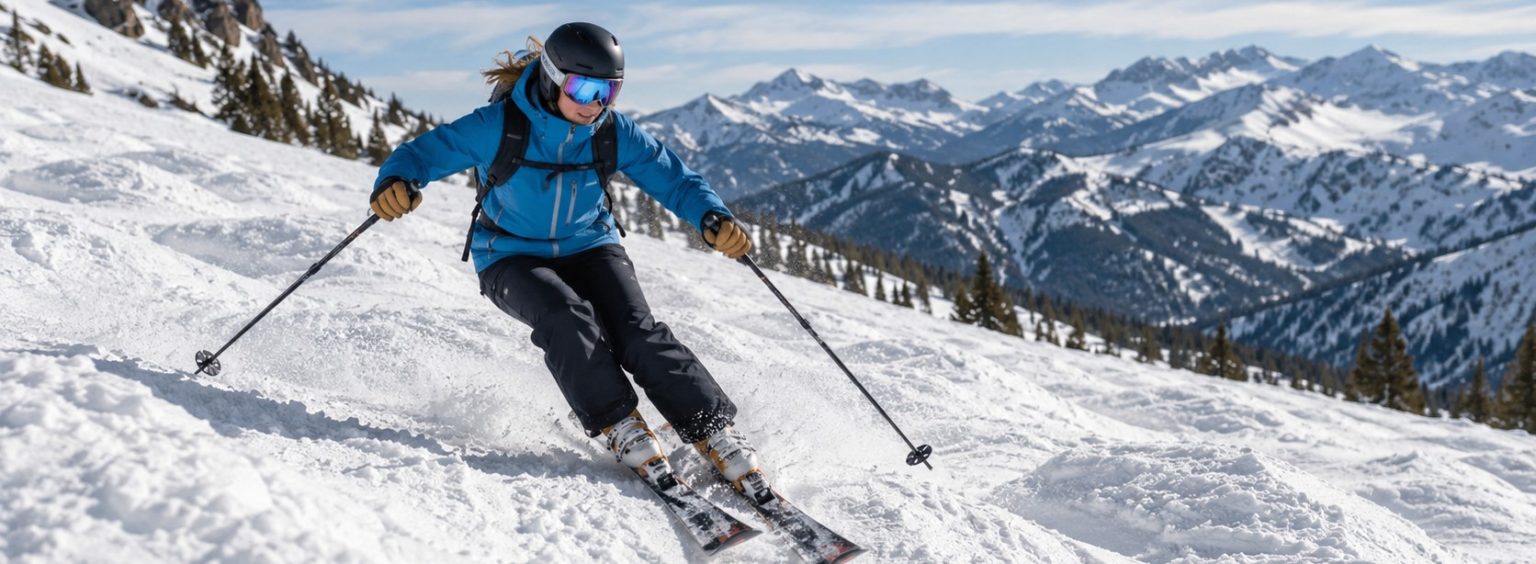
To start ski touring as a woman, begin on a marked uphill route at a resort, with light gear matched to your build and boots with a women’s liner. Then get avalanche training with a club or a guide before leaving the groomed runs: a transceiver, shovel and probe are not enough without practice.
Why a guide written for women? Because ski touring is still mostly told in the masculine. Tanya Naville, who founded the Women’s Skimo Project (presented by Ski Planet, in French), points out that the media show few women ski tourers. As a result, many women hesitate for lack of role models, suitable advice or partners to go out with. The gear has moved on, though: manufacturers now offer skis, boots and skins designed for lighter builds and narrower feet. With a well-built progression, you can discover the pleasure of the climb and of untracked snow calmly, at your own pace.
What is ski touring, and why take it up?
Ski touring means climbing slopes under your own power, thanks to skins stuck under your skis, then skiing back down. The bindings free your heel on the way up and lock it for the descent. You alternate an endurance effort, close to mountain hiking, with the pleasure of skiing. In North America you will also hear “backcountry skiing”, “skinning” or, at resorts, “uphilling”.
The sport keeps winning converts. According to Mon séjour en montagne (in French), it has reached new audiences, notably city dwellers looking for a cardio activity, and the Covid winter, when lifts were closed in several countries, accelerated the boom. For you, it is a chance to ski away from the crowds, build fitness and see the mountains differently.
What changes when you start as a woman?
Technically, nothing: skinning, kick turns and the descent are learned the same way. But a few points deserve your attention:
- Gear weight. On the climb, you lift every gram with every step. A light setup matched to your weight and height makes the first outings far more enjoyable.
- Boot fit. Women’s models often have a liner and cuff reworked for narrower feet and lower calves. For example, the Dynafit TLT X women’s boot (spec sheet in French) comes in Mondopoint sizes 23 to 27.5, with a heat-mouldable liner and a stated weight of 930 g (about 2 lb) per boot.
- The group. Joining a guided outing or a women’s touring group makes it easier to ask questions, climb at your own pace and build confidence.
What gear do you need to start ski touring?
Before buying, rent. Most resort and mountain-town shops offer complete touring packages by the day or week, so you can test several models before investing. Here is the basic kit:
| Equipment | What it does | What to watch for as a woman |
|---|---|---|
| Touring skis | Climb and descend | Favour light weight and a length matched to your height and weight |
| Touring (free-heel) bindings | Free the heel for the climb | Release values set for your weight: have them checked in a shop |
| Climbing skins | Grip the snow on the way up | Cut to the exact width of your skis |
| Touring boots | Walk and ski | Walk mode, cuff range of motion, women’s liner for hold |
| Transceiver, shovel, probe | Be found and rescue others in an avalanche | Essential outside secured routes, and useless without training |
| Backpack and essentials | Carry your gear | Short back length and adjusted straps; warm layers, food, emergency blanket, first-aid kit |
For clothing, think in layers: a breathable layer for the climb, a windproof shell in the pack and a light puffy for breaks and the descent. You sweat a lot going up, then cool down fast at the top.
Where can you do your first outings safely?
The best playground for beginners is a marked uphill route at a resort. In the Alps these routes are permanent, signposted and secured, and you ski down on the groomed runs. A few French examples noted by Mon séjour en montagne:
- Méribel: the Pic Bleu route, 5.5 km (3.4 miles) and 600 m (about 1,970 ft) of climbing from Méribel Village, groomed, marked and open during lift hours.
- Arêches: three secured, patrolled tracks totalling 9 km, one of them free to access.
- Val Thorens: the Petite Sud and Grande Sud routes.
Elsewhere the principle is the same but the rules differ. Many North American resorts publish an uphill policy with designated routes, set hours and sometimes an uphill pass. Check with the tourist office or the resort website before you go, and never skin up the middle of an open run: stay on the designated track.
How do you train for safety before leaving the groomed runs?
Leaving secured routes means entering unpatrolled terrain, where avalanche risk exists. The safety recommendations of the French mountaineering federation FFME (in French) set out clear basics:
- Everyone carries the trio of avalanche transceiver (beacon), shovel and probe, checks the transceiver’s batteries before every outing and practises searches regularly.
- You read the avalanche bulletin for your area, which rates danger from 1 to 5. Careful: level 3 is not “average”, it is “considerable”.
- Slopes steeper than 30° call for particular vigilance: never stop for a break on one.
- Avoid going out alone, and tell someone your route and return time.
The FFME also notes that about 90% of buried victims are alive when the avalanche stops, but their chances fall sharply after 10 minutes. That is why fast companion rescue is decisive. An introductory avalanche course (AIARE 1 in the United States, AST 1 in Canada, or the courses run by alpine clubs and mountain guides in Europe) is the standard first step.
The Xtremself tip: for your first outings outside a resort, go with a certified mountain guide or an alpine club. You will learn to read terrain, use a transceiver and choose a route in a reassuring setting. No equipment guarantees absolute safety: training and caution make the difference.
How do you progress step by step?
Here is a simple progression for your first season:
- Rent a complete package and have the bindings set for your weight and boot size.
- Do a short first climb on a marked resort route, with no thought of performance.
- Learn the basic moves: putting skins on and taking them off, switching from climb mode to ski mode, making a kick turn.
- Gradually lengthen the vertical of your outings, always on secured routes.
- Take an avalanche safety course with a club or a guide before your first tour outside a resort.
How do you prepare physically and manage the effort uphill?
The climb mostly taxes endurance and legs. The key is a steady rhythm you could hold for a long time while chatting. Better to climb slowly without stopping than fast with repeated breaks. Slide your skis forward in small steps without lifting them, and drink regularly.
Preparation before the season makes a real difference: running, cycling, uphill hiking, and strength work for thighs and core. After the outing, eat, rehydrate and stretch. If you are still building your downhill skills, start with our beginner ski guide for women; you will find all our advice in the Xtremself skiing section.
Read next:
- Skiing for beginners: the women’s guide
- Ski or snowboard for beginners
- Skiing while pregnant: is it safe?
Frequently asked questions
It is best to be comfortable on red runs (advanced blues in North America) before you start. Skinning is quick to learn, but the descent is sometimes on ungroomed snow. On a marked resort route you come down on the groomed runs, which makes a first try more accessible.
Not necessarily. Women’s models are often lighter and come in shorter lengths, which helps lighter skiers. The main thing is to try: rent before you buy and choose according to your weight, height and level.
Marked resort routes are secured, but carrying the transceiver, shovel and probe trio is still recommended. Outside secured routes, the FFME recommends that every person carries it and knows how to use it.
Stay modest: a few hundred metres (roughly 1,000 ft) of vertical on a marked track is enough to learn the technique without exhausting yourself. Build up gradually, keeping energy for the descent.
Ask your doctor before resuming or continuing: the effort of the climb and the risk of falling on the descent need to be assessed case by case.
