


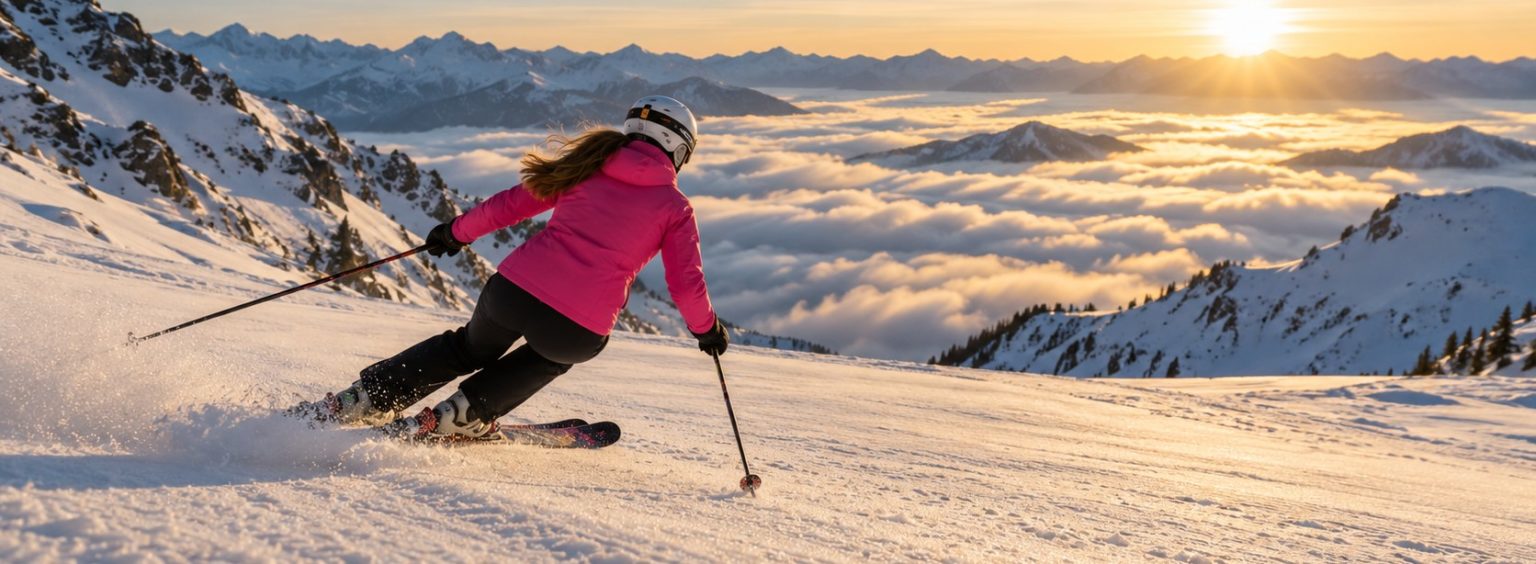
Skiing while pregnant: official guidance advises against downhill skiing throughout pregnancy because of the risk of falls and collisions. There is no “safe until” date: the decision is one to make with your doctor or midwife. If you do ski, stick to easy runs, moderate altitude, and stop at the first unusual sign.
You have skied for years, the trip is booked, and then a positive test changes the picture. Should you cancel, ski “gently”, or wait until next winter? Skiing while pregnant is a topic where lift-queue advice contradicts itself: one friend skied until five months, another did not clip in all season. What matters is your body, which changes week by week, and your pregnancy, which is unique. This guide gathers what medical sources actually say, so you can have an informed conversation with the person looking after your pregnancy.
Can you ski while pregnant?
The official sources agree. The American College of Obstetricians and Gynecologists (ACOG) does not recommend activities that raise the risk of injury or falls during pregnancy, and downhill skiing is one of the examples given (MotherToBaby fact sheet on exercise during pregnancy). In the UK, the NHS says that activities with a risk of falling, including downhill skiing, horse riding and cycling, “should only be done with caution” because a fall can harm the baby (NHS advice on exercise in pregnancy). The pregnancy charity Tommy’s lists skiing among the activities to avoid (Tommy’s guide to exercise in pregnancy), and France’s public health agency gives the same advice for the same reason (Santé publique France guidance on physical activity in pregnancy (in French)).
None of this is a judgment on your level, or an invitation to stay still. Physical activity is recommended in a healthy pregnancy: ACOG advises at least 150 minutes of moderate activity a week, and walking, swimming, yoga and gentle strength work are all good options. The problem with skiing is the fall and the impact, which even an expert skier cannot fully control.
Multiple pregnancy, bleeding, a history of preterm birth: some situations rule out most sports. Only your doctor, obstetrician or midwife can assess yours.
Skiing while pregnant: how late can you ski?
It is the most common question, and the honest answer is this: none of the sources we consulted sets a number of weeks before which skiing while pregnant would be safe. The guidance is built around the risk of falling, which exists from the very start. What changes over the months is your balance and the possible consequences of an impact.
| Stage | What changes | What the guidance says |
|---|---|---|
| First trimester | The bump barely shows, but the pregnancy is under way. | Your usual activity is generally possible without chasing performance, but skiing is still listed among the fall-risk sports to avoid or approach with caution (ACOG, NHS). |
| From the 4th month | A growing bump shifts your centre of gravity: balance gets harder and falls more likely (Santé publique France). The baby is also less shielded by your pelvis. | In the second trimester, avoid competition, intense efforts and contact or fall-risk sports (French Ministry of Sports guide). |
| From the 8th month | Fatigue and discomfort increase. | Favour walking, gentle exercise or swimming. |
In other words, the further along you are, the more the arguments against skiing pile up. If you are planning a trip, raise it early with your healthcare professional, ideally before booking.
Why is downhill skiing discouraged during pregnancy?
Falls and collisions
You control your own skiing, not everyone else’s. A collision with another skier or snowboarder, an icy patch or a roller you did not see is all it takes. MotherToBaby, a US information service that draws on ACOG recommendations, explains that the chance of falling in activities such as downhill skiing can be higher in pregnancy because of changes in balance.
Balance and joints that change
From around the fourth month, the bump moves your centre of gravity and balance becomes trickier. Pregnancy hormones also loosen the ligaments, which raises the risk of sprains and strains. In a sport where the knees take so much load, that matters.
Altitude and effort
The NHS advises against exercising above 2,500 m (about 8,200 ft) because of the risk of altitude sickness for you and your baby. MotherToBaby is stricter: exercise above 6,000 ft (roughly 1,800 m) is not recommended because less oxygen is available. Many resorts go well beyond that: base villages in Colorado often sit above 8,000 ft, and the big Alpine ski areas top out above 3,000 m. Add the cold, long days outside and lifts you cannot get off whenever you like.
Set on skiing while pregnant? The precautions to take
If, after talking it through with your doctor or midwife, you decide to put your skis on, reduce the risk as far as you can, keeping in mind that it never disappears.
- Get medical advice before you leave, and mention the altitude of the resort, of your accommodation and the kind of skiing you have in mind.
- Stay on wide, groomed green or blue runs, and forget about speed.
- Ski at quiet times and avoid peak weeks and busy home runs to limit the risk of collision.
- Skip icy snow, fog, off-piste and the terrain park.
- Keep the intensity moderate. The “talk test” is the usual benchmark: you should be able to hold a conversation while you ski.
- Take frequent breaks, drink and eat regularly.
- Wear a helmet, knowing it protects neither your bump nor you from falling.
- Do not ski alone, and locate ski patrol and the nearest medical centre.
- Check your travel insurance: many policies exclude or restrict winter sports during pregnancy.
The Xtremself tip: decide before you leave what you will do once there, with two lists: “yes” (a walk, the pool, a sunny terrace) and “no” (red and black runs, off-piste, full days). In resort, the pull of “just one run” is strong; a decision made calmly at home protects you better than one made at the top of the chairlift.
Which signs mean you should stop immediately?
Stop the activity and seek medical advice if you notice any of these warning signs, listed in the “Activity during pregnancy” leaflet from Nice University Hospital (in French) and consistent with ACOG’s own list:
- vaginal bleeding;
- dizziness, feeling faint or a headache;
- chest pain;
- pain or swelling in a calf;
- painful uterine contractions;
- fluid leaking from the vagina;
- your baby moving less than usual.
If you feel faint, lie down on your left side. After a fall or a blow, even without pain, get medical advice straight away.
What to do in the mountains when you are pregnant
A ski trip does not confine you to the chalet. Walking, swimming, yoga and gentle exercise are all recommended in pregnancy: a stroll on a flat, groomed winter path, the resort pool or spa (check the temperature rules with your midwife), a stretching session at the end of the day. Snowshoeing or cross-country skiing on flat terrain are worth discussing with your midwife: slower than downhill skiing, they still involve falls.
As with any change in your body, listening to it comes before the programme. And when the time comes to get back on snow, with the green light from your healthcare professional, our beginner ski guide for women will help you find your feet again at your own pace. Find all our articles in the women’s skiing section.
Read next:
- Skiing for beginners: the women’s guide
- Ski or snowboard: which one to start with?
- Ski touring for women: how to get started
Frequently asked questions
The guidance makes no exception for early pregnancy: ACOG and the NHS both list downhill skiing among the fall-risk activities to avoid or approach with caution. A bump that barely shows does not protect you from a fall or a collision. Talk to your doctor or midwife before any trip.
On flat terrain, cross-country skiing involves less speed and fewer collisions than downhill skiing, but it still carries a risk of falling. It is a decision to make with your healthcare professional, at moderate intensity: you should be able to talk while you exercise.
The NHS advises against exercising above 2,500 m (about 8,200 ft). MotherToBaby, which draws on ACOG recommendations, does not recommend exercise above 6,000 ft (around 1,800 m). Ask for medical advice and take the altitude of your accommodation into account too.
Stop skiing and get medical advice straight away, even if nothing hurts. Seek urgent care if you have bleeding, fluid loss, painful contractions or reduced baby movements.
No. Snowboarding also exposes you to falls and collisions, and the same recommendations apply: it is one of the board sports to avoid during pregnancy unless your doctor advises otherwise.
