


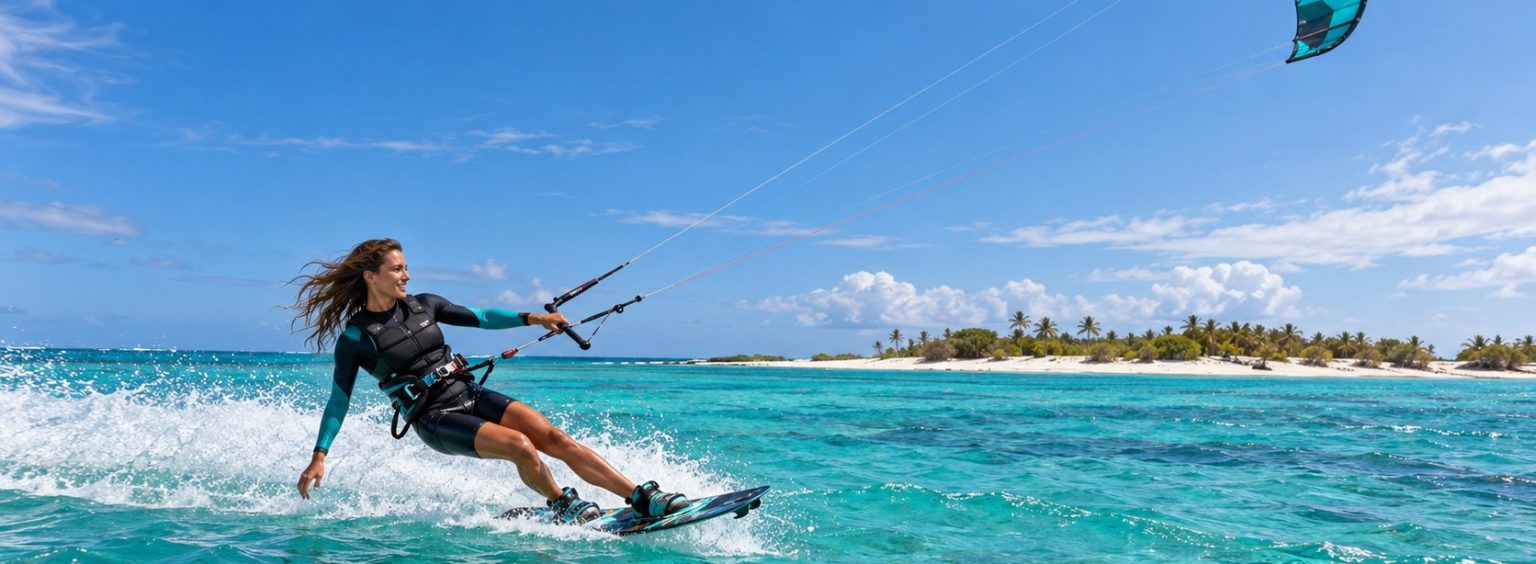
To pick a winter kitesurfing destination in the sun, follow the trade winds: Dakhla in Morocco and Cape Verde a few hours from Europe, the Caribbean from December to April, or New Caledonia and Hawaii for a long-haul trip. Match the spot to your level: a shallow lagoon to progress, waves for experienced riders.
From November to March, home waters across Europe and much of North America turn cold, the days get short and the wind arrives in rough frontal bursts. Plenty of kitesurfers pack their gear away… or head for the sun. For a woman, choosing a winter spot deserves a few extra criteria: at a lighter body weight, very strong wind quickly becomes hard to handle, whereas steady, moderate wind lets you ride a sensibly sized kite. Safety on site, serious schools and how easy it is to travel solo or with friends matter too. Here are our pointers for choosing your winter kitesurfing destination.
Why go kitesurfing in the sun in winter?
Riding at home in winter is possible, but it takes a thick wetsuit, booties, a hood and a good tolerance for cold. Sessions are shorter and fatigue sets in faster. Heading for the sun changes everything:
- warm water, so you ride in a shorty or a thin suit and move more freely;
- steady thermal or trade winds, easier to plan around than winter storms;
- longer sessions, ideal for an intensive course or for breaking through a plateau (first runs, riding upwind, first jumps);
- a welcome break in the middle of winter, so you come back in spring with real progress.
Which winter kitesurfing destination for which month?
The table below sums up the main options. The periods are guidelines: always check the wind statistics for the exact spot before booking.
| Destination | Best winter window | Water | Level |
|---|---|---|---|
| Dakhla (Morocco) | All year, winter included | Flat, shallow lagoon | Beginner to advanced |
| Cape Verde (Sal, Boa Vista) | Winter trade-wind season | Sheltered flat spots and wave spots | Intermediate to advanced |
| Caribbean (St Barts, Martinique, Guadeloupe and neighbours) | December to April | Protected lagoons and bays with swell | Beginner to advanced |
| Northeast Brazil | Early winter (end of the dry, windy season) | Lagoons and long beaches | Beginner to advanced |
| New Caledonia | November to April | Lagoon, islets, west coast | Intermediate to advanced |
| Hawaii (Maui) | November to March | Powerful waves | Advanced only |
Dakhla: a warm lagoon to progress
On the Dakhla peninsula, the lagoon is a huge flat-water playground with areas less than a metre (about 3 ft) deep, very reassuring for learning or drilling a manoeuvre. Statistics for the Ocean Vagabond spot published by Windy show a rideable season from January to December, with 10 to 12 m² kites most often used. Over the full year, Windfinder records an average wind of 16 knots. It often blows harder in the afternoon: if you are light, pack a small kite or rent on site.
Cape Verde: trade winds and Atlantic atmosphere
Sal and Boa Vista catch the trade winds through the northern winter. You will find more sheltered zones to progress and wave spots reserved for confident riders. The wind is generally stronger and gustier than in a lagoon: it is a good destination for a second or third season, with a school to point you to the right spot each day.
The Caribbean: turquoise lagoons and reliable trades
According to Figaro Nautisme (in French), the trade winds blow in St Barts from December to April, with water around 26°C (79°F). The Grand Cul-de-Sac lagoon, shallow and protected by a coral reef, suits beginners, while the bays more exposed to swell are best left to experienced riders. Martinique and Guadeloupe offer comparable conditions, and the same winter trade winds sweep the neighbouring islands, which makes the region an easy pick from North America as well as Europe.
Brazil, New Caledonia and Hawaii: the big trips
Northeast Brazil is famous for its lagoons and long windy beaches; in November and December, check that your dates still fall within the wind season. New Caledonia enjoys, according to the same source, constant trade winds of 20 to 25 knots from November to April, with water often above 27°C (81°F). Finally, Maui attracts experienced wave riders from November to March: it is a high-level spot, with access rules on some beaches.
How do you choose a winter kitesurfing destination for your level?
The right winter destination is first of all the one that matches how you ride. If you are just starting out, read our kitesurfing guide for beginners before you leave.
- Beginner: go for a lagoon where you can stand, steady wind and a certified school (IKO or equivalent) with supervised lessons, radio helmets and a rescue boat.
- Intermediate: a large flat-water area to work on riding upwind, then a few sessions at a more committing spot with an instructor.
- Advanced: waves, downwinders, remote spots… provided you know the currents and never ride alone.
What gear should you pack for a winter kite trip in the sun?
No need to travel with a giant board bag: many schools rent recent gear, which saves you baggage fees and lets you try several kite sizes. If you do fly with your quiver, check the airline’s sports-equipment allowance. To choose well, see our guide on how to choose a kite for your level and the conditions and our kitesurfing equipment checklist.
- Your harness, adjusted to your body shape (it is the most personal item).
- A wetsuit suited to the water temperature: shorty or thin full suit, plus a UV rash guard.
- Water-resistant, reef-safe sunscreen, sunglasses with a retainer and a cap.
- A helmet and impact vest if you are learning or riding near reefs.
- Insurance documents that explicitly cover kitesurfing abroad.
The Xtremself tip: before you book, ask the local school which kite sizes it stocks for your weight. At very windy spots, a light rider may need a smaller kite than the standard rental fleet offers. And build in a day or two of margin: even in the trade winds, wind is never guaranteed.
Travelling solo or with other women: how to prepare your kite trip
Many women kitesurfers travel alone or with friends. A few simple precautions make for a calmer stay:
- choose a recognised school and read recent reviews, checking that it runs a rescue boat;
- look for women’s kite camps or weeks, which several centres now offer;
- always tell someone your session times, and never ride alone at a spot you do not know;
- find out about local customs (dress away from the beach, getting around at night) and the country’s entry requirements.
On the water, the rules are the same everywhere: right of way, distance from swimmers, self-rescue. Refresh them before you go, and do not skip a lesson on self-rescue if you have never practised it.
What budget should you plan for a winter kitesurfing trip?
The cost of a winter kite trip depends mostly on the flight, the length of stay and the package. Nearby destinations such as Morocco or Cape Verde are the most affordable from Europe, the Caribbean plays that role from North America, and New Caledonia or Hawaii are long-haul projects for almost everyone. To compare, add up: flight and sports baggage, accommodation, lessons or gear rental, insurance and transfers. Centre “packages” (accommodation plus course) often simplify things, especially for a first trip. Find all our advice in the women’s kitesurfing section.
Read next:
- Kitesurfing for beginners: the complete guide
- Kitesurfing equipment: what you really need
- How to choose your kite
Frequently asked questions
The nearest options are Morocco, with the Dakhla lagoon, and Cape Verde, two areas exposed to the trade winds in winter. Both are a few hours’ flight away and have plenty of schools.
Choose flat water where you can stand, such as the Dakhla lagoon or a Caribbean lagoon like Grand Cul-de-Sac in St Barts, with a certified school supervising the lessons.
Yes, if you are properly equipped: thick wetsuit, booties, gloves or a hood depending on the water temperature. Sessions are shorter and the wind stronger, which makes cold-water winter riding better suited to independent riders.
You do not have to: most schools rent kites, boards and harnesses. Bringing at least your own harness and wetsuit is a good compromise for comfort.
The trade winds blow mainly from December to April, a period that coincides with the dry season and warm water.
