


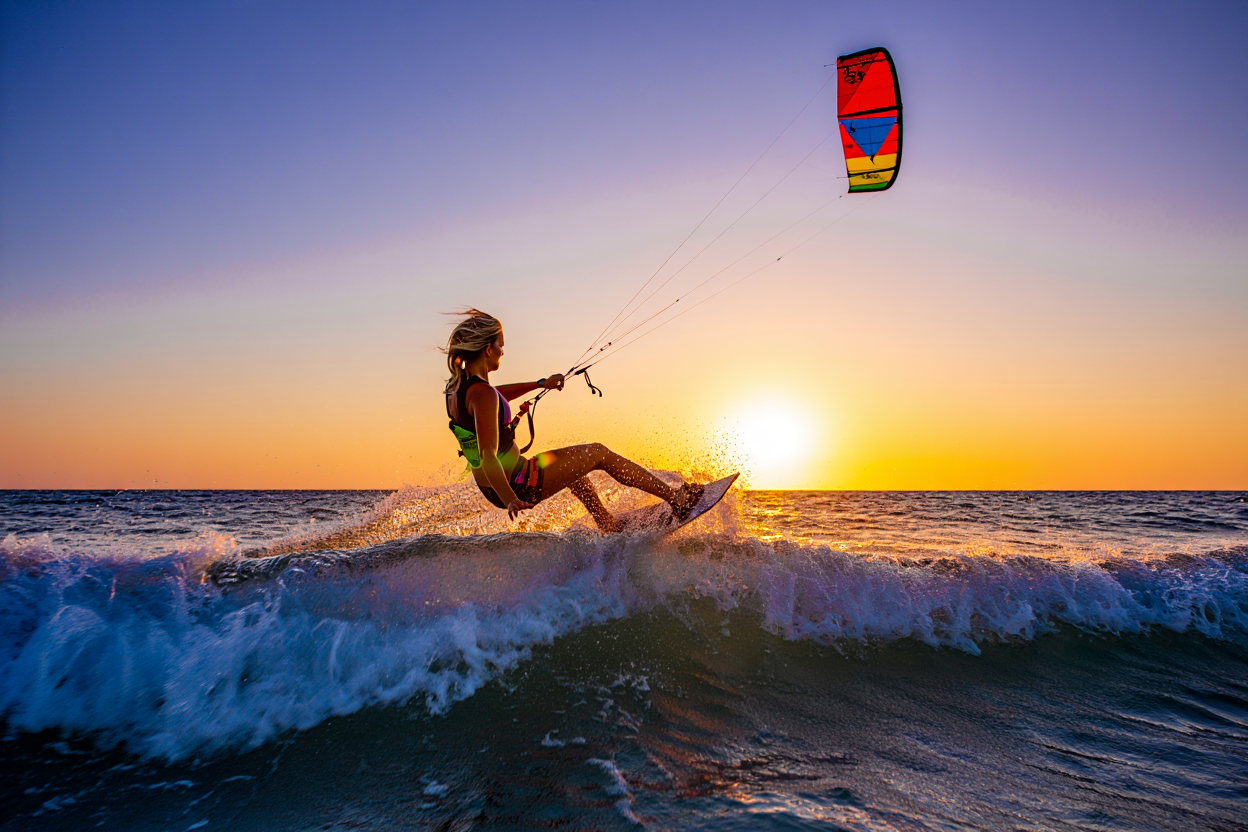
To choose a kitesurfing kite, start from three criteria: your level, your weight and the wind strength at your spot. As a beginner, favour a hybrid or delta kite, stable and with plenty of depower. The lighter you are, the smaller the kite you need for the same wind.
The kite is the engine of kitesurfing. It catches the wind and pulls you across the water. Yet many riders underestimate this choice and go out on a borrowed kite that is too big or too technical for them. This guide helps you choose a kite suited to your level, your build and the day’s wind forecast, so you progress faster and more safely.
Why does kite choice matter so much?
An ill-suited kite makes riding hard work, even dangerous. Too big, and it pulls too hard and lifts you off the water in gusts: you are “overpowered”. Too small, and it lacks power and stops you riding upwind. A well-chosen kite makes riding smooth and leaves you the energy to work on technique.
For a woman the question is even more concrete: most size charts are built around a rider of about 75 kg (165 lb). If you weigh 55 or 60 kg (120 to 130 lb), applying those figures without adjusting them means riding with too much power. Before you buy, also read our guide to choosing your kitesurfing equipment as a whole.
Which kite for your level?
Beginner: a stable kite that depowers easily
While you are learning, look for stability above all. According to the kite buying guide from the French retailer Flysurf (in French), a beginner needs a stable kite, fairly slow through the air, with a little power always available to get out of the water. Hybrid and delta kites fit the bill. The same guide says they let you shed 80 to 90% of the power by letting go of the bar, which is the foundation of safety when you start.
At this stage, buy nothing before you have taken lessons. The school lends you suitable gear and teaches you to set it up. Our kitesurfing guide for beginners details those first steps.
Intermediate: go for versatility
You ride upwind, you turn without dropping the kite and you are trying your first jumps. A versatile freeride kite, often a hybrid, will see you through cruising, small jumps and first tricks. It stays forgiving while being more responsive than a school kite.
Advanced: refine by riding style
With a good level you can choose a specialised kite. In freestyle, riders like C-kites, powerful and direct. In waves, you want a light, agile kite that drifts well with the swell. For big air, a powerful kite with long hang time. At this level your own sensations count as much as the spec sheet.
Which kite shapes exist, and which suit women?
Manufacturers offer several shapes. The table below sums up their differences, based on the Flysurf guide.
| Kite type | Characteristics | Who for? |
|---|---|---|
| Hybrid | Most of the market, between C-shape and bow, very wide depower range | Beginner to advanced: the all-round choice |
| Delta | Closed arc, swept-back leading edge, good depower | Beginners and improvers, easy relaunch |
| Bow | Flatter centre section, forgiving in gusty wind, less direct feel | An older concept, mostly found second-hand |
| C-shape | Constant pull and direct feel, narrower wind range | Advanced freestyle or wakestyle riders |
| Foil (ram-air) | Stable, can be very large, more technical | Mostly land and snow, or very light wind |
For a light rider, the point is not to find a “women’s” kite: very few models are gendered. What matters is a bar that is easy to handle, effective depower and a size matched to your weight.
Which kite size for the wind and your weight?
The rule is simple: the lighter the wind, the bigger the kite; the stronger the wind, the smaller. Weight works the same way: the lighter you are, the less area you need to plane in the same wind. Here are the indicative ranges published by Flysurf from manufacturers’ data, for a 75 kg (165 lb) rider.
| Kite size | Indicative wind range in knots (75 kg / 165 lb rider) |
|---|---|
| 6 m² | 20 to 35 |
| 8 m² | 18 to 30 |
| 10 m² | 15 to 28 |
| 12 m² | 12 to 25 |
| 14 m² | 8 to 18 |
Flysurf does not state the unit in its chart; the ranges correspond to wind speeds in knots, the unit kite forecasts use. The guide stresses that they are approximate, especially at the top end. If you weigh well under 75 kg, take the next size down for the same wind, and ask your instructor or a shop to confirm against the model’s own chart.
The “Rescue and kitesurfing” guidelines from the French sea-rescue service SNSM (in French) note that kites run from about 3 m² for very strong wind to 18 m² for very light wind, and that people generally ride between force 3–4 and force 8 on the Beaufort scale. They also record that serious accidents happen in strong, gusty winds of 25 to 40 knots. Those conditions are for very experienced riders only.
How do you read the forecast before pumping up?
Choosing the right kite starts the day before, with the forecast. Go through these steps before every session:
- Look at the average wind AND the gusts: a big gap between the two signals irregular wind, harder to handle.
- Check the wind direction: never ride in offshore wind, which pushes you out to sea. The SNSM says so explicitly.
- Choose your size from the average wind and your weight, leaving margin for gusts.
- On site, watch the water: other riders, whitecaps, obstacles, swimmers. If the most experienced riders are sizing down, do the same.
- If in any doubt, rig a smaller kite or stay on the beach: nobody regrets a session cut short.
Flysurf advises giving up when the average wind is around 25 knots with gusts to 40, unless you have the right kite and are used to those conditions.
Do you need two kites?
A single kite covers a limited wind range. That is why many independent riders end up with a two-kite quiver: a big one for light-wind days and a smaller one for stronger wind. Together they cover most conditions at their home spot.
It is not a priority when you start, though. Begin by renting or buying one versatile kite matched to the most frequent wind at your spot. With use you will see whether you are short of power or of margin in strong wind. Travelling to ride? See our winter kitesurfing destinations guide, and ask the local school which sizes it rents for your weight.
Which safety systems should you check with your kite?
A kite is not chosen on its own: it works with its bar and safety systems. The SNSM guidelines describe three essential elements:
- The bar’s quick release: it detaches you from the bar; the kite loses its power and falls.
- The kite leash: the kite stays connected to you after the release, without pull, so you do not lose it.
- The leash release: it frees you from the kite completely in a serious emergency.
Test these systems on land before each session: they work differently from brand to brand. The SNSM also recommends wearing a wetsuit, a buoyancy vest and a helmet, and riding with a buddy or telling someone your area and return time.
The Xtremself tip: before buying, note the average wind of your sessions for a few weeks. Choose your first kite for that wind, not for the exceptional days. And try it first: many schools and shops run demo days on the beach.
All our guides are gathered in the kitesurfing section.
Frequently asked questions
There is no single size: it all depends on the wind. In the same wind, a 55 kg rider needs a smaller kite than the 75 kg rider most charts are based on. Start from the model’s chart, size down if in doubt and ask your instructor.
A hybrid or delta kite: stable, fairly slow through the air and with plenty of depower. These kites shed most of their power when you let go of the bar, which makes learning safer. Take lessons on the school’s gear before buying.
Yes, at first. Choose a versatile kite suited to the most frequent wind at your spot. As they progress, many riders add a second kite, bigger or smaller, to ride in more conditions.
Reduce power with the bar’s depower and head towards the shore. If you are still overpowered, come in and switch to a smaller kite. In danger, use the quick release: the kite loses its power and stays attached to you by the leash.
Very few models are specifically for women. What matters is a size matched to your weight, a bar that is easy to handle and effective depower.
Read next in our kitesurfing gear series:
- Kitesurfing for beginners: the guide
- Choosing your kitesurfing equipment
- Winter kitesurfing destinations
